They say if you look hard enough, you find your way back home
If you have ever felt self-destructive, and if your brain has ever spoken to you in words of flames, then you might hear memories of yourself in Cornell.

I heard Chris Cornell long before I ever really heard Soundgarden. If you are of a shared vintage — old now, but not yet ancient — there was a time when “Black Hole Sun” was everywhere. Maybe on the radio, or a TV screen somewhere, or it was a moving chorus from the window of a car driving swiftly past. I likely heard it first on a mixtape, possibly the one some guy made for my older sister somewhere in the mid ‘90s, I have mentioned before. That tape had everything, and has become mythical in its own way, like any good mixtape lost to time can be. As if a single tape held in a plastic container branded by Memorex could form the foundation below an entire life.
Soundgarden, the band and not just a man, was present on “Black Hole Sun” of course, but Cornell’s voice is what I heard first. This is the nature of men with a voice like his, at once a silken baritone and others a soaring tenor, octaves stacked upon each other so tall they might touch the sky. All pained and yearning. The rumour at the time was that the line no one sings like you anymore was about Cobain, whose death the year before lingered between the lines of everything that came after, and with time the line now wonders who could ever sing like Cornell.
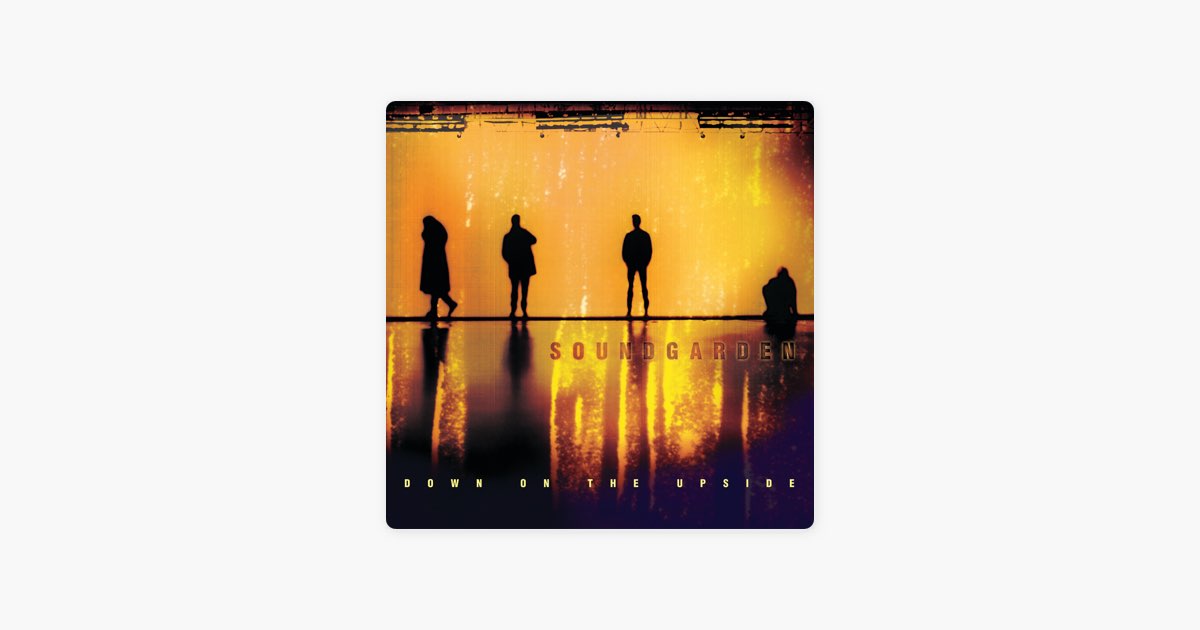
We are in the wake of two anniversaries — Cornell’s passing in 2017 and the release of the final proper Soundgarden album, Down on the Upside, in 1996. I am going to blaspheme just a little, and it’s not my intention, but as with so many sins it’s a by-product of a persistent and intrusive thought. If every good band has a Pet Sounds in them — and pray that they do — then Down on the Upside is Soundgarden’s. Which isn’t to say that it’s the dazzling masterwork of an artist fighting to make sense of a fractured mind, but rather that it’s a kind of controlled burn. A man eager to lay the forest bare and see what may grow from the ashes and timber left behind.
Where much of Soundgarden’s work was a collaborative effort — Kim Thayil, Matt Shepherd, Matt Cameron, and original bassist Hiro Yamamoto greatly contributed to the writing process on their previous albums — Down On The Upside was a tighter focus on Cornell’s desires. He wanted to move away from the heavy riffs of their wild and reckless youth and move towards something new, an expansive empire of sound. They brought in mandolins and mandolas and played in odd time signatures. The songs were slower, less propulsive, but no less heavy. Cornell feels more at the front of the record than ever before, with his voice and his lyrics and the vision he was, perhaps, trying to interpret. What emerged was a beautiful and brash record. Loud as creation in parts, reserved and pensive in others. There is darkness in the weeds of it, almost overgrown and endless. At times, and on the right listen, it’s overwhelming. As if a song could serve as the soundtrack for the edge of a cliff, daring to fall into oblivion.
If you have ever felt self-destructive, and if your brain has ever spoken to you in words of flames, then you might hear memories of yourself in Cornell. On Down On The Upside this comes through all too clear. In their previous work, that darkness had at times been an abstract spectre, hidden behind tremendous pillars of riffs and pounding rhythm. Even “Black Hole Sun”, despite the rumours of its lyrics, was morbid nonsense strung beautifully together. Like a poem formed by magnets on a fridge in a fit of despair. But the songs on Down on the Upside were something more. The layers peeled away to reveal the raw timbre of Cornell’s shaky frame, sharing loudly of himself, perhaps with hope that someone might hear what secrets lived between all the subtle nods and muted truths.
So it was for me in 1996 with my own desires for self-destruction. I felt a kinship with Cornell, pensively wailing why doesn’t anyone believe in loneliness on “Zero Chance.” Just as I don’t recall the first time I heard “Black Hole Sun”, I don’t recall the first time I knew my brain whispered dangerous words to my spirit, I just know that its always been there. Every little truth that becomes a clinical word if you stick around long enough to hear them diagnosed for you.

I didn’t know with any certainty that Cornell held such darkness in him when I was young and discovering Soundgarden, but I knew it was there. As if I were hearing someone speak in a language I thought I had invented whole cloth. It was impossible to ignore or turn away from. How desperate he was to turn all the bitter parts of his worst impulses into something big and loud and everlasting. Maybe by expelling them he could be free of their hooks and tendrils, and that he never escaped them is no failing of his or anyone. It’s just the way these things go, and there is no greater tragedy than this.
But still, he made the scary parts of himself into something beautiful. Cornell’s voice is clear on Down On The Upside, even when it’s sad and searching it is built of such powerful beauty. On the “Blow Up The Outside World”, he moves effortlessly from pensively wandering through the fields of his feelings, and it’s only when it’s time to holler blow up the outside world that whatever rage he holds in the other hand is released. More cathartic than pained or angry. The flicker of words in his head that could only be extinguished when given to melody.


This is not a record I return to in my adult years, despite my fondness for it. I know it’s not the favourite record of Soundgarden’s fandom, nor is it the choice of greatest hits archivists, but there is something beautiful in it. It’s a hard thing to give such a powerful voice to so much desperate pain. To make the darkest parts of you the sword and shied in your hands. I know that Cornell suffered in the depths of his depression, struggled with substances and anxious thoughts, and so many afflictions that feel all too familiar.
I have lived far longer than I ever expected, and have been haunted by so many like Cobain and Cornell whose lives were cut short by the whispers of their brains they could not escape. I am lucky to be here to remember the days that are long gone now, of when a record like Down On the Upside spoke so clearly to me. I have had so many of my secrets turned into something clinical, and in turn these have healed me in some way. Whatever sadness I live with is present without danger, and without need for expulsion, like it once was. When I hear Cornell’s voice howling at the moon in revisiting this record, all I can hear is the desperate feelings of days gone. A man who grew old but never ancient, eager to make sense of all the broken pieces, that they might make such a clear picture of the world still to come.
For Jukedocs, my music doc series at HotDocs, we're screening I Am Trying to Break Your Heart: a film about Wilco in June. Tickets here!
My partners band, By Divine Right, is doing some shows with the great Casper Skulls! Info on those here