Pray for a true peace in space
I had no words for myself in the late 1980s when I obsessed over Metroid in the basement, only ideas. Desires that questioned the body, how it might be broken down and rebuilt into something better, even when I was so young.
The TV of my youth was hidden away in the basement, on a patch of carpet that covered the concrete floor like an island. Never quite touching the walls or the sea. Our TV was a large and heavy wooden thing, with brass-coated buttons for volume, power, and a number pad, and a decaying set of rabbit ears held to the unfinished basement ceiling with duct tape and copper wire. This was a perfect system created by my dad, holding the antennae at just the right angle that they might catch a TV signal and allow us a clear view of daytime Canadian broadcasting.
It was in the basement because our TV was heavy and an unwieldy nuisance and so it was to be forgotten, or at least not noticed. My dad has never been one for television, would rather listen to music or read in the living room when he was not at work and so the TV was somewhere else. Alone in our cavernous basement, where no one could be distracted by its incessant desire to be perceived.
It was a surprise then when my sister and I got a Nintendo for Christmas in the late 1980s because we barely had use for our TV at all. We rented a VCR on odd weekends, and my dad would pay for basic cable for a few months in the winter, then cut it off again as spring melted away the bitter snow. Getting a Nintendo, complete with a light gun and the game pack that had Super Mario Brothers and Duck Hunt in one, was like tearing away at the veil between all possible timelines. A view of life and a house with a TV that served some kind of greater purpose, never to be ignored, and together we spent hours shooting fake ducks with a passive-aggressive dog and shaking the controller in hopes it would make Mario jump better in the face of so much death.
We couldn’t afford to own many games, so any others we had were hand-me-downs, or purchased used from the video rental place below the Chinese food restaurant by the bowling alley. I picked up a formerly loved copy of Metroid with a mostly intact instruction manual with what little money I had, and with it, games became an obsession I fell into alone.
Metroid, in its first form, was a video game starring an intergalactic bounty hunter named Samus Aran. The instruction book told me that he was the greatest of all the space hunters, but his body was not his own. It had been built, and rebuilt, in order to make someone perfect. A cannon for an arm, and a suit that could adapt to any environment, within which anything became possible. At the start of the game, you are nothing.
At the start of the game, you are a man that rides a sad elevator down to an underground cavern, hollow and empty, populated by bugs and aliens and mysteries that move in the dark. Backed by a haunting, discordant soundtrack, that only added to this desperate atmosphere. At the start of the game, you are no one, the hollow idea of a man, who has to build himself from all the hidden secrets of the world so that you might survive.
I played this game in the basement with minimal lighting. The volume just loud enough that only I could hear it. Its haunting noises became my own. At the start of the game, I was no one. Alone in an empty basement where everything is placed to be ignored and out of sight. Metroid tricks you. In all the other games I knew, you had to go right to start. Go right to explore. Go right to win. Always follow this path, the same path that anyone might follow. In Metroid, though, if you go right you will get stuck. If you follow the same footsteps that have tamped every other path, you will find nothing. All dead ends and locked doors. It’s imperative to your survival that you go back, and go left. Jump up and over, find a secret artifact. It allows Samus’ body to bend and break, and curl into a ball. As if collapsing the universe upon itself, to build new possibility. In the game I was no one, but then this simple power made me someone new, and suddenly, I could be anything at all.
Metroid follows this pattern over and again. Doors are locked, or the environment in certain areas impassable. It’s only by losing yourself in the darkness, haunted by the dissonant soundtrack, that you will eventually find answers. At each turn, Samus has to find a power up to keep going, each one changing the suit Samus wears. It is armour, and it is the body. As if whatever steel or hardened thing that clads it is skin and sinew. By building substance onto Samus’ once hollow body, doors unlock and pathways open. In the basement, I am no one. In the game, Samus is slowly building a new body from the one that entered. The body that emerged into the hollow and dark expanse will never leave this place. It can’t. This body, forgotten and put away, hidden out of sight, will never survive. It will be destroyed, and rebuilt, and this is how it will survive, even if that doesn’t feel right at first.
It took forever just to learn to go left, never right. Explore. Look around. I made notes in a little notebook that was supposed to be for school, and my mom begrudgingly bought me a new one. This one, the first one, was ruined now, with my maps and notes and scribbles. Ruined by tracking all the secrets of the world. The layout of areas, where enemies linger in the dark, and where the body becomes something new.
I read the instruction manual, what pages remained in the used copy I had, and poured over the backstory and rudimentary controls. I sketched them all in my notebook too, as if I was suddenly a historian, building elaborate records of Samus, alone in this dark and forgotten place. Out of sight, and so out of history. If I didn’t catalogue each step of this journey, then there would be no one to remember it.
This core mechanic of Metroid, the exploration, the realization that a door is locked, or that an area is inhospitable, but only for now, has remained the same throughout all future permutations of the series. It's the great strength of Metroid, adapted by so many other games that its very name has become a genre. This idea that you will have to take note of where you have been, and where you have been held back so that you might return and conquer all the doors and beasts that held you at arms length.
I never beat the first Metroid, released 40 years ago now in August 1986, and so I discovered the game's great secret through alternate means. My cousin, visiting from Vancouver with his family, told me that there was a secret password in the game that would show me something cool. The game had no internal battery, could save no data, and so you were reliant on passwords to save progress, which I had scribbled in my sprawling mess of a notebook. If you typed JUSTIN BAILEY, with underscores below each letter, the game would open its greatest locked door, and reveal that the Samus who is referred to by “he” in the instruction manual, is a woman.
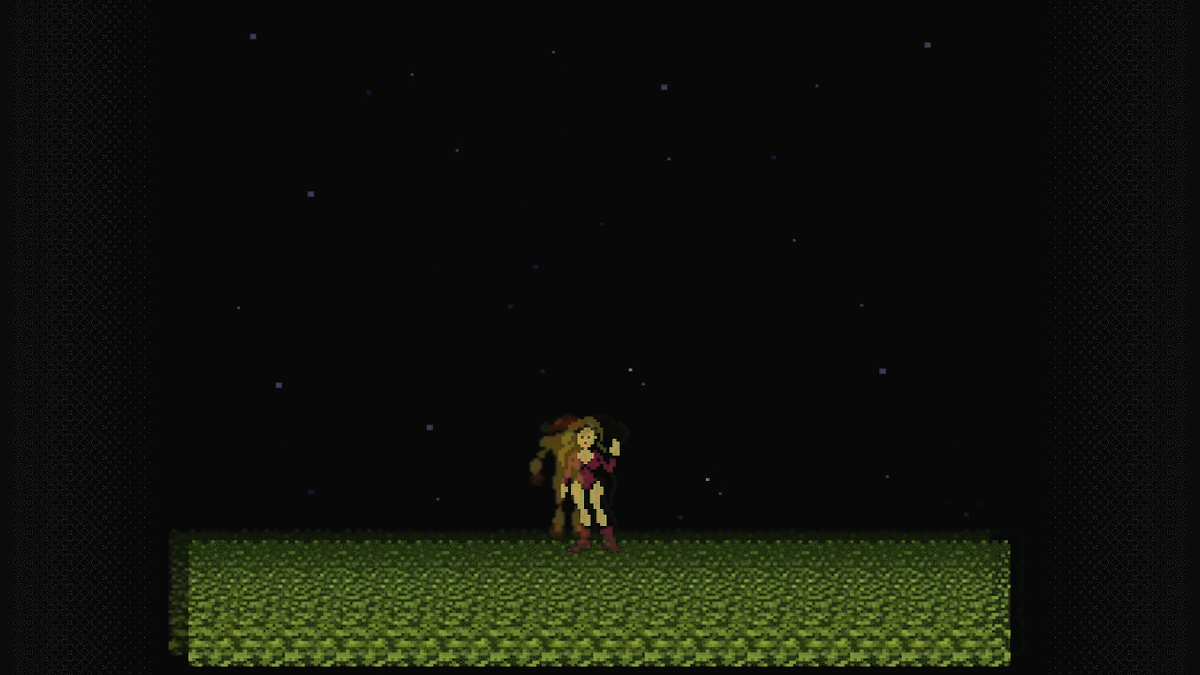
This is revealed at the end of the game, after defeating the final boss, where Samus stands under a wall of text that congratulates you, and speaks victoriously about achieving peace in space. If it takes you too long to beat the game, Samus simply holds an arm in triumph. Beat it fast enough, though, and the suit slowly disappears. Occasionally, the helmet is gone, revealing Samus’ long hair, but beat it fast enough and the suit disappears entirely to reveal Samus in a purple bodysuit, or faster still a bikini.
Regardless of which ending you get, the message remains the same. That at the outset, in all instruction and guidance, you started this journey as a man, hollow and alone. Strong and proud and eager for battle, and the only way out was to become lost, to go left despite only ever knowing turning right. To break the body down into a ball. Into an atom of itself. To go back and enter through all the doors that felt impossible once. The body will break and bend and adapt, and it will never leave this place. Not as it was. To survive you have to allow the skin to shift and change, let your bones break and rebuild, and allow your final form to be revealed. Live long enough to see it through. Catalogue your journey, remember how to survive.
I had no words for myself in the late 1980s when I obsessed over Metroid in the basement, only ideas. Desires that questioned the body, how it might be broken down and rebuilt into something better, even when I was so young. When I would clomp around in my mom’s old horse riding gear and announce I would grow up to be like her. Adults laughed and commented on how cute it was because how could any of us had known? It would be different now, but no less hard. All the locked doors and hidden places, where danger lurks in the dark. But I have a map that I drew, and I know its secrets now.
I cheated victory, or rather the reveal at the taste of it, but it felt the same regardless. That after all this time and exploration, all the setbacks and frustrations at getting lost, it was revealed that my character had changed and become a woman by these trials. The body that entered could never be the one that leaves. The core element of the game, all the exploring and fighting and going back to impossible places, meant that it and I were changing. Becoming better by virtue of all this endless struggle. The body made whole by the time credits hit that final screen.
Don't forget you can buy my book, The Dad Rock That Made Me a Woman, anywhere you buy books (support your local indie) or audiobooks (fuck Amazon, support Libro.fm)
I've been loving this record Lysh played at home the other day. The debut record from an artist named Milly Strange, that feels a little like Hope Sandoval in parts and spirit, or maybe just the better parts of all the hidden corners of 90s indie rock. It's perfectly moody and haunting, and I love the wavering tones of her voice. It's a perfect morning coffee record.
 swanbabe