Down bad
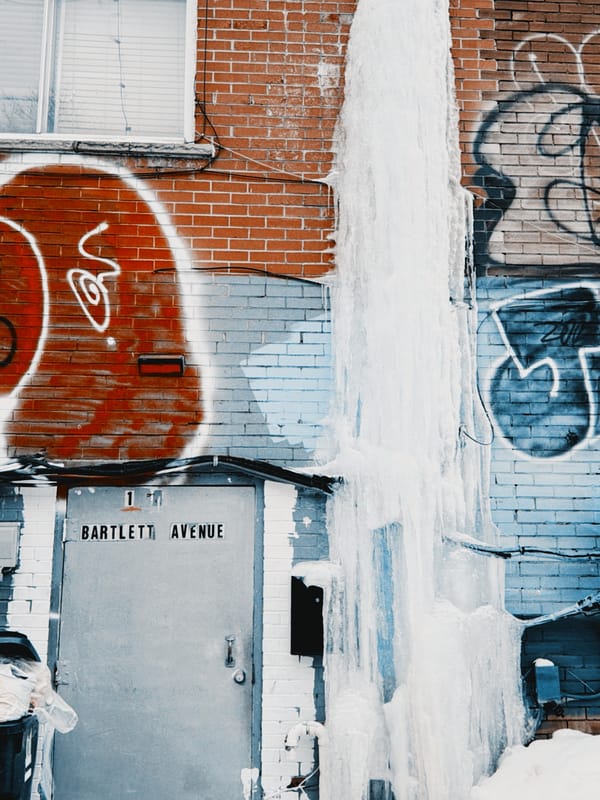
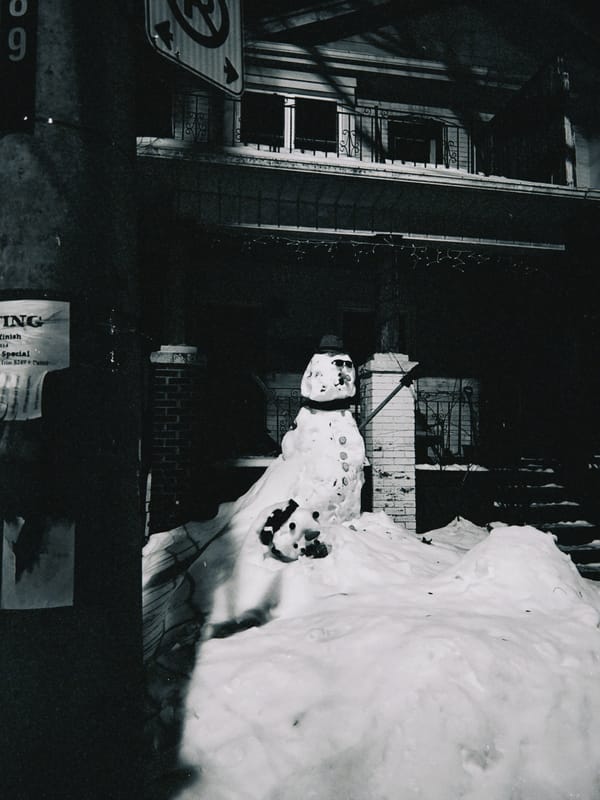
An act of clearing by just putting all the extra snow in scores of uneven piles that are half on the sidewalk and half on the street, ensuring that at least this way no one will ever run the risk of being terribly happy
There is a persistent image of Canadians as nice and polite, all off us well-mannered and even-keeled people hidden below what hair escapes the confines of our toques, smiles masked by scarves knit by polite neighbours. All affirmations and apologies, and this is true enough, depending on where and how you look, and it is also a lie. My regular haunts lean enough into the stereotype to remain pleasant, staff smile and make idle chatter, regular customers at the butcher shop and the coffee shop and the corner store all thrive in the ecosystem we create together. But this is not all perfect, and I worry sometimes about the wolves at the door, howling only because they have been inside before and would like to return.
The other night I slipped hard on the ice while walking Bowie down the street, a road near us plagued by snowfall, and the disastrous reaction to snowfall, in west end Toronto. An act of clearing by just putting all the extra snow in scores of uneven piles that are half on the sidewalk and half on the street, ensuring that at least this way no one will ever run the risk of being terribly happy. Sidewalks populated by the husks of empty recycling bins, their lid frozen open turned over on the sides turning walks at night and the early morning into an obstacle course that offers no prize for swift completion. All of this is just in the way for no reason. I slipped, and Bowie cried because I surely must have yanked the leash hard when my body was parallel to the ground in the seconds before the two had a violent meeting.
I have chronic pain issues stemming from the injuries my body has absorbed over my many years of manual labour, and a slip like this means my body will hurt for days to come. In truth, it might never feel good again. Every time it hurts to walk and move and stand and lean over, it feels like it will always feel this way. As I struggled to reign in Bowie, who was alarmed and a little in shock, removed from his routine of sniffing snow that he wants to eat piled at the end of lawns buried in the stuff, I noticed a car idling in the driveway just beyond me. I could see a woman inside, impatiently waiting for the recycling truck in the street behind her to move so she could complete this half-reverse her car was in. Half in her driveway, half on the street, covering the sidewalk. I saw her watch me struggle to my feet, shake the ice off myself best I could, my arm still a little numb from the shock. I saw her get annoyed at me when I motioned with my hands for her to at least move off the sidewalk. I saw her mouth grumble in complaint, how annoying it must be to sit in a car when this crumbling husk of a body that just slammed into the pavement from life’s top ropes wants to get by. I walked into the street between her and the recycling truck and felt the exhaust hit my nose like smelling salts, bringing me back to life.
I still wonder how she could have watched me fall so hard and so fast and not find it in herself to roll down the window and ask if I was okay. All of us polite and well-mannered people.
The next morning I saw a post on a Toronto subreddit of a man on his way to work with an SS sticker on his hard hat. I see posts of people spotting nazi slogans as vanity plates in Atlantic Canada, and iron crosses tattooed on the arms of the men who check to see if you paid your bus fare. These are the wolves, and this is what I mean when I say that Canada as it is perceived is not real. It is a lie we tell ourselves as Canadians, post about fear and the rising distrust of Americans, as if Americans are the reason for the problems that bear down on them. As if the Americans standing against ICE in the streets and organizing with their communities to ensure their collective safety are somehow the problem.
We have our own problems here, like so much snow moved unevenly off the street onto the sidewalks. We have fascists just waiting to grasp at power, and fascists who already have it. I have seen enough terrible AI artwork that reads “Canada needs ICE” to know that our problems are becoming louder, and it is to our benefit to rise in solidarity with our neighbours to the south and on all our imaginary borders and say we will not stand for this, and we will stand with you. We will ask if you are okay.
Fuck ICE, free Palestine, go birds.

Bruce Springsteen wrote a song about what's going on in Minneapolis, and the world beyond it, called “Streets of Minneapolis”. I posted about this already on Bluesky, the few I saw bemoaning how earnest and cringe — a word I believe has been stripped down to the bare wood of its meaning — it is. Springsteen is always going to be this man, a heart so worn into his sleeve it has become a scar on the skin below. It is easy to wave away the merit of an earnest response to such an urgent problem, and harder maybe to accept the value of someone of Springsteens standing releasing a song that recalls the name of a man murdered in the street by an unchecked federal agency, that ends with audio of a collective chant ICE OUT. He is cringe, but he is free, and if more people that held public sway could say the same we would be in a far better place.
There is a new Joyce Manor album, I Used To Go To This Bar, and it is exactly what the exhausted corners of me needed. I was a punk rock kid in the days before we started to call everything with a vibrant melody pop-punk, and it has been one of the great pleasures of aging that the genre I loved in my youth has grown in time. It is no less vibrant, power chords build the same familiar structures, choruses ring with aggressive harmonies, but the subject has shifted in time. Where once it was all depressed young men wailing forlornly about love lost, now it is something more. Now it’s about death and loss and the fear of what becomes of us as we age. It is joyful and triumphant and a little fearful, but willing to move ahead and find out despite all the hesitancy of the unknown, and there is so much beauty in that.
I posted my last newsletter too soon to share this, but I was pleasantly surprised to discover that Al Green had a new EP, on which he covers “Everybody Hurts” with beautiful poignancy. His voice, strained by the years, still holding so much of the glory of when its younger breath, that is only given texture by the Reverend’s history and the days on this earth. When he tells you that if you think you’ve had enough, to just hold on, it feels earned in a way that Michael Stipe could not claim when the song was new and beautiful. This is not a knock on the R.E.M original, it is just the changing nature of songs and the stories in them. How they hit different with time bearing down on them. How the sun on the pages that built them has worn and weathered all things, and made them tender and brittle, but somehow more beautiful than before. Worth holding on to, now with greater care, in hopes they stay forever.
Wrote a little for CBC Arts about Canadian media needing to get back to its greatest strength: making weird TV. You can read it here
Was on the news talking about the sad news of Catherine O’Hara’s passing, you can watch that here
I have a podcast with my friend Alex Steed, The OC, Again, you can listen to it here